




The Concept
A schema registry for every industry
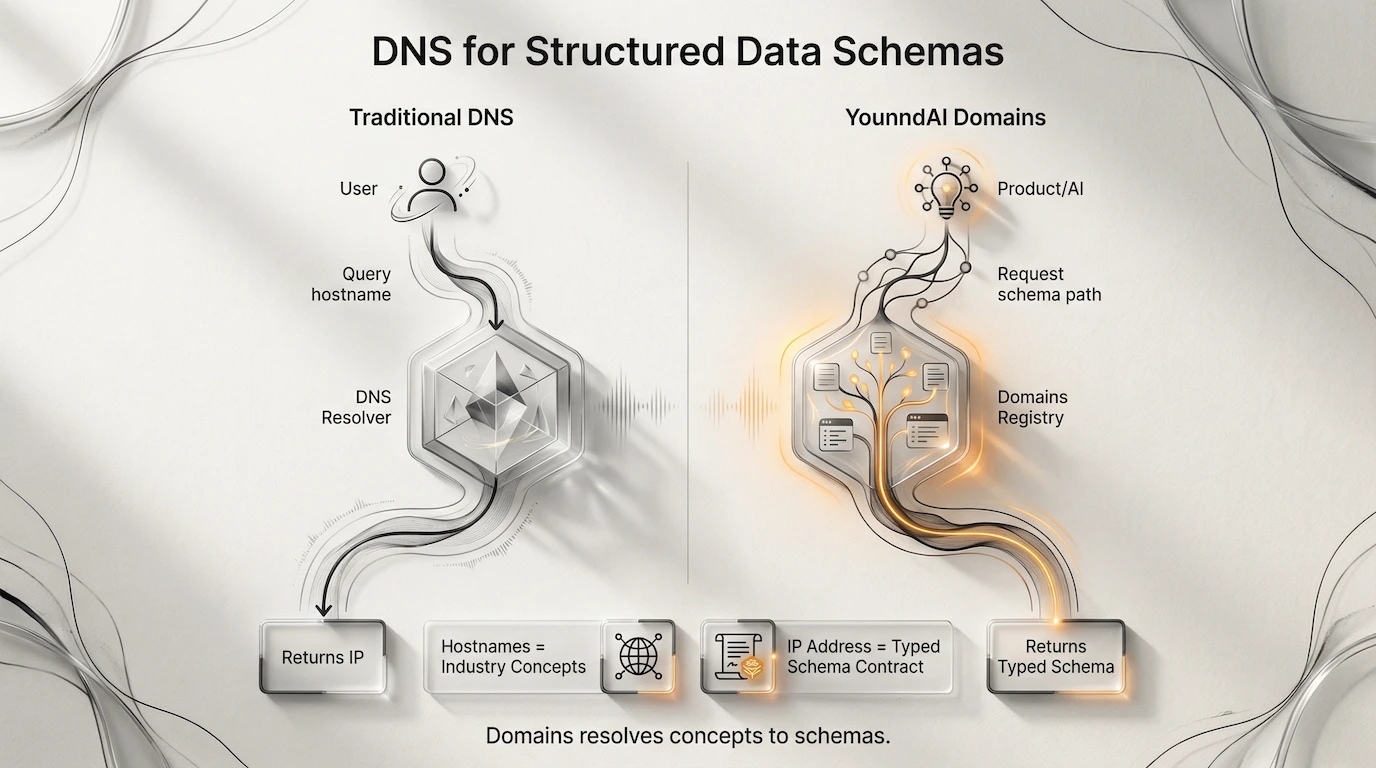
DNS for structured data schemas. A managed registry of typed industry schemas. Each domain defines tags with typed fields, validation rules, and trust signals. Request a schema by path, get a typed contract back.
DNS resolves hostnames to IPs. Domains resolves industry concepts to schemas.
The Audience
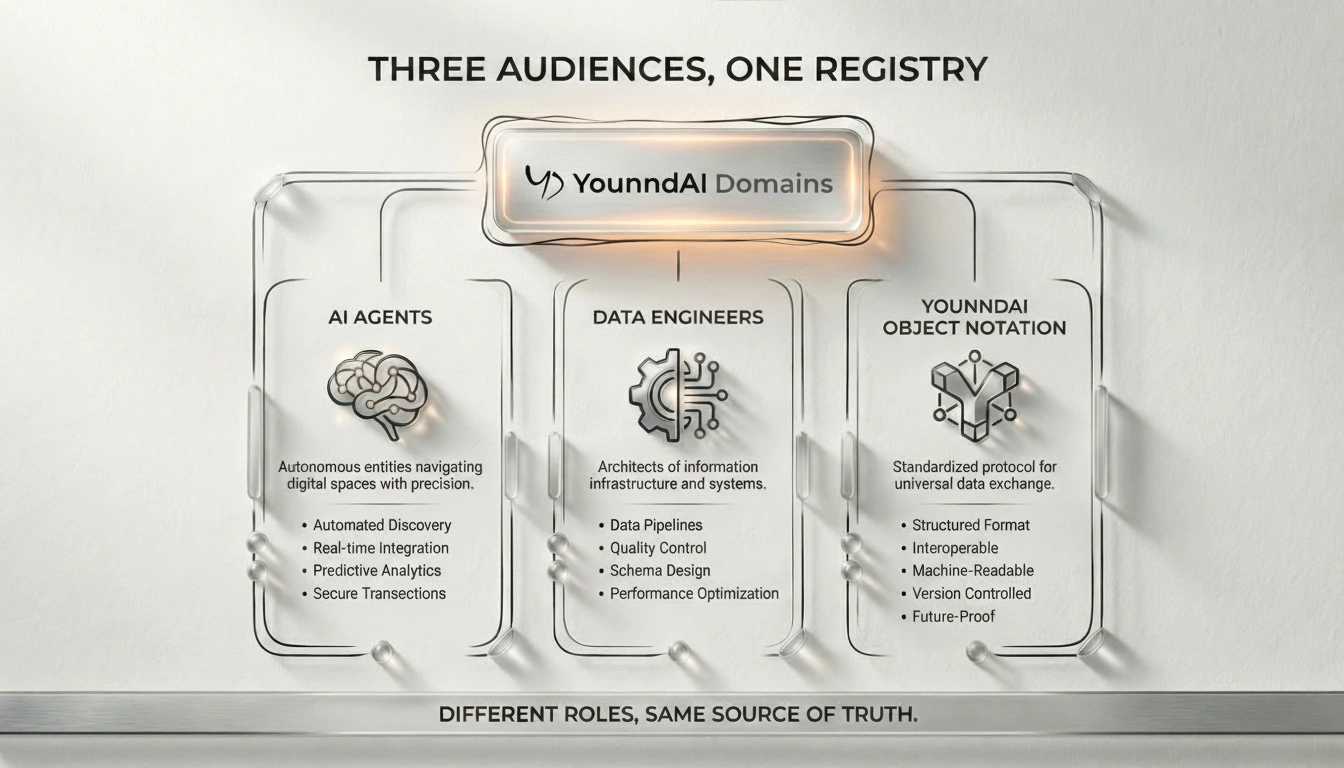
Three audiences, one registry. AI agents, data engineers, and YON document authors consume the same schema definitions — versioned, immutable, and queryable by path.
AI Agents
Fetch domain schemas at runtime. Get typed field definitions, validation rules, and industry context — no training data required.
Data Engineers
Standardize pipelines across teams and industries. One schema per domain, versioned and immutable. Pin, cache, validate.
YON Users
Write structured documents with industry-specific tags. The parser fetches schemas from the registry, validates fields, and scores conformance.
The Structure
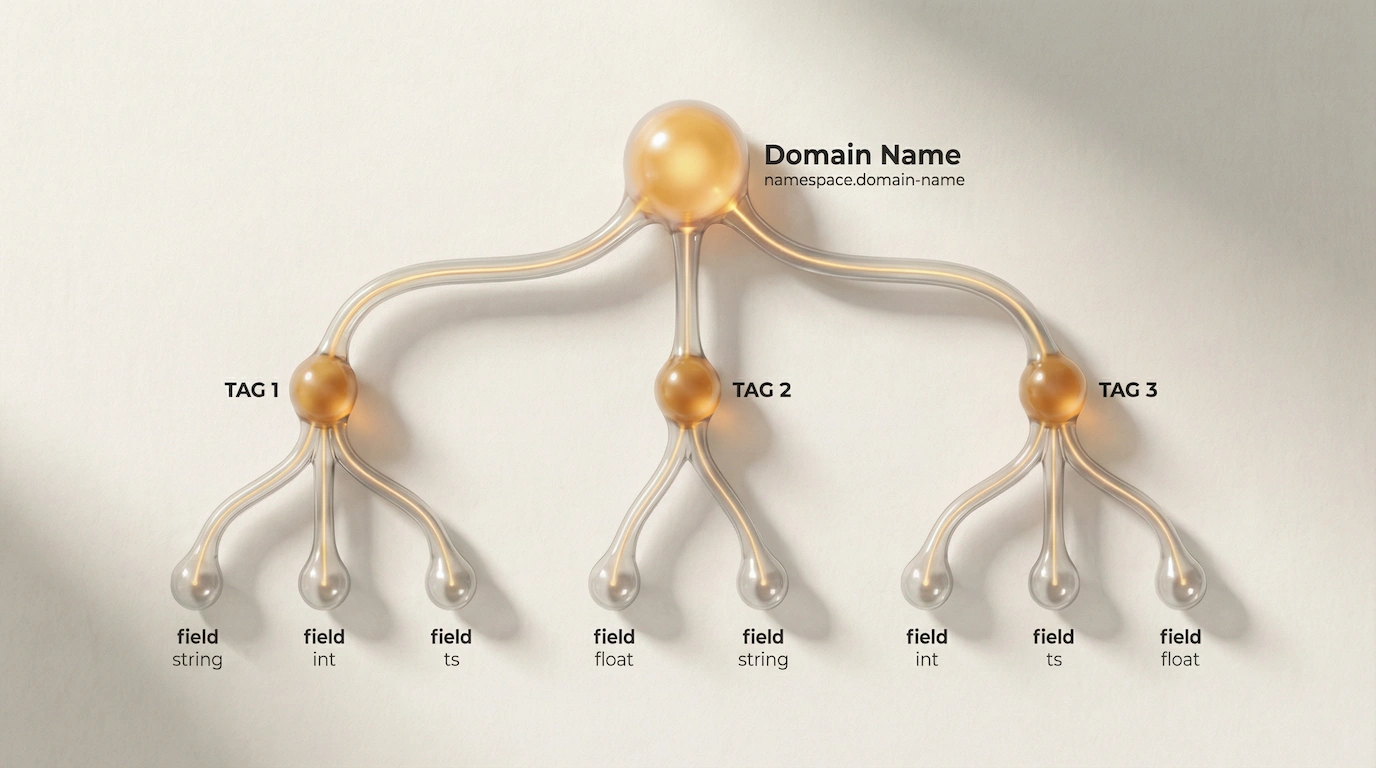
Domain → Tag → Field
Domains organize industry knowledge into typed schemas. Tags define structured records. Fields carry type, range, pattern, and validation constraints.
Domain
An industry namespace. Healthcare, finance, logistics — 31 official domains ship with the standard.
Tag (Schema)
A named record type within a domain. VITALS, INVOICE, WAYPOINT — each tag defines a structured contract.
Field (Variable)
A typed property with constraints. Type, range, pattern, required — everything a parser or AI agent needs.
Schema Discovery
Explore 31 official domains across healthcare, finance, logistics, and more. Filter by tier, namespace, or conformance.
Tags & Fields
Every tag defines typed fields with validation — type, range, pattern, required. Self-describing schemas that parsers and AI agents understand.
Trust & Conformance
Verified publishers. Conformance scores from 0 to 1. Operational health notices. Four signals — one trust profile.
Immutable Versions
Pin a version. Cache forever. Content hashing guarantees schema integrity across deployments.
The Problem
AI needs to understand your data
AI is infrastructure now. It processes, connects, and coordinates across systems.
But AI cannot interconnect when every system defines different terms for the same concepts. Every integration becomes custom-built, fragile, and expensive.
Agents need two things: a shared grammar to structure any record, and a shared vocabulary to name the fields each industry already uses.
YON provides the grammar. Domains provide the vocabulary. When both are shared, interoperability emerges — zero new software, zero integration code.
@DOC ver=2.0 | id=vitals-check | title="Patient vitals" | domain=yon.health
@VITALS bp="120/80" | hr:int=72 | spo2:float=98
@DX code=J20.9 | system=ICD-10
The Use Case
Three domains. Three agents. One patient.
A patient is discharged. A claim is filed. A payment settles. Each agent reads a domain schema for its vocabulary, then writes spec-compliant YON.
yon.healthDomain Schema (partial)
{
  "tag": "PATIENT",
  "fields": [
    { "name": "mrn",    "type": "string" },
    { "name": "gender", "type": "string",
      "enum": ["male","female","other","unknown"] },
    { "name": "active", "type": "bool" }
  ]
},
{
  "tag": "DX",
  "fields": [
    { "name": "code",   "type": "string" },
    { "name": "system", "type": "string",
      "enum": ["ICD-10","SNOMED-CT","ICD-11"] },
    { "name": "severity", "type": "string" }
  ]
},
{
  "tag": "RX",
  "fields": [
    { "name": "drug",   "type": "string" },
    { "name": "dosage", "type": "string" },
    { "name": "route",  "type": "string",
      "enum": ["oral","iv","im","topical","inhaled"] }
  ]
}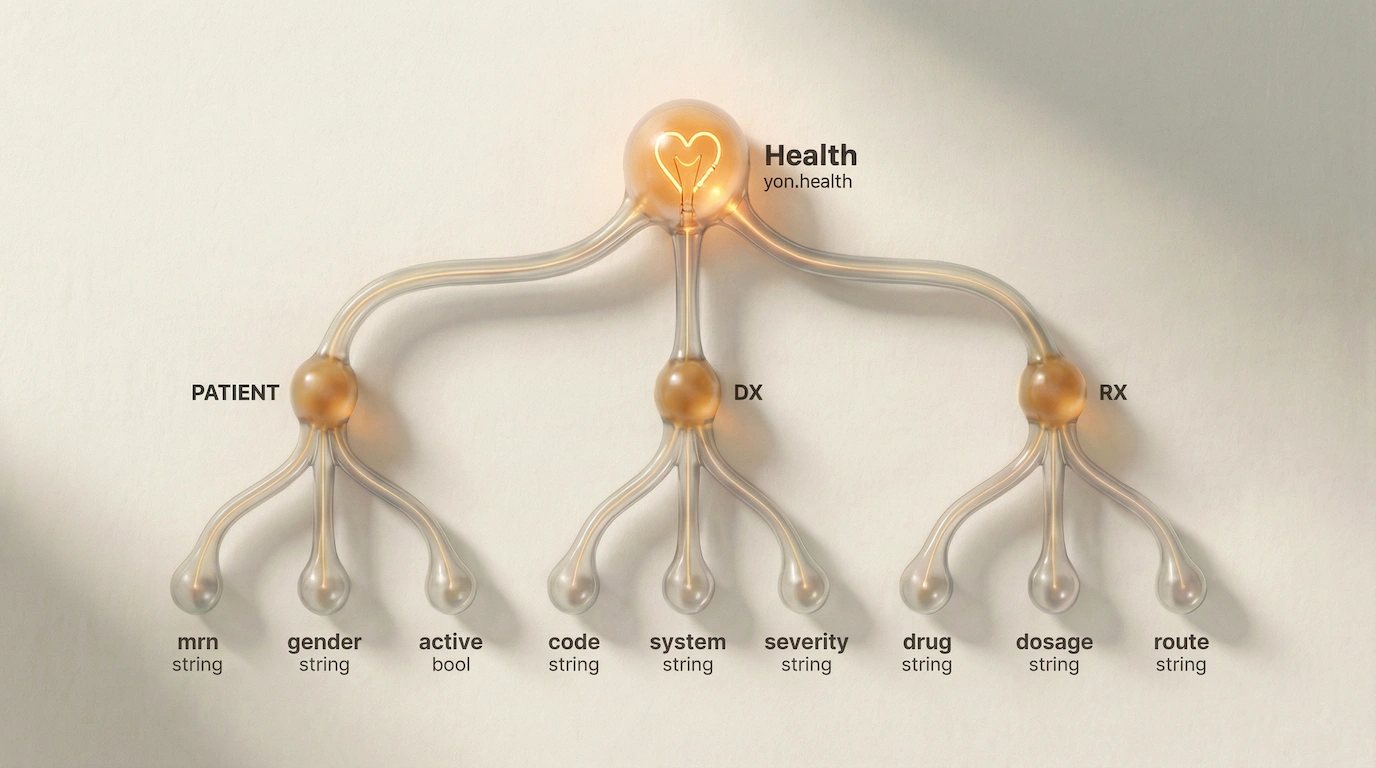
A partial excerpt from yon.health — 3 of 12 record types. The hospital agent reads these tags, fields, and enums to structure its discharge.
View full schema →

YON — YounndAI Object Notation
@DOC ver=2.0 | id=discharge-2847 | title="Discharge summary" | domain=yon.health | profile=audit
@PATIENT rid=pt:2847 | mrn=MH-2847 | gender=female | active:bool=true
@DX rid=dx:1 | code=J20.9 | system=ICD-10 | description="Acute bronchitis" | severity=moderate
@RX rid=rx:1 | drug=Amoxicillin | dosage=500mg | frequency=three-daily | route=oral | status=active
@STAMP ts:ts="2026-02-24T14:30:00Z" | src=agent:hospital-ai | method=generatedyon.insuranceDomain Schema (partial)
{
  "tag": "CLAIM",
  "fields": [
    { "name": "rid",            "type": "string", "required": true },
    { "name": "policy_ref",     "type": "string" },
    { "name": "loss_type",      "type": "string" },
    { "name": "amount_claimed", "type": "float" },
    { "name": "status", "type": "string",
      "enum": ["reported","under-investigation",
               "approved","denied","settled"] }
  ]
},
{
  "tag": "COVERAGE",
  "fields": [
    { "name": "peril",  "type": "string" },
    { "name": "limit",  "type": "float" },
    { "name": "coinsurance_pct", "type": "float",
      "range": [0, 100] }
  ]
}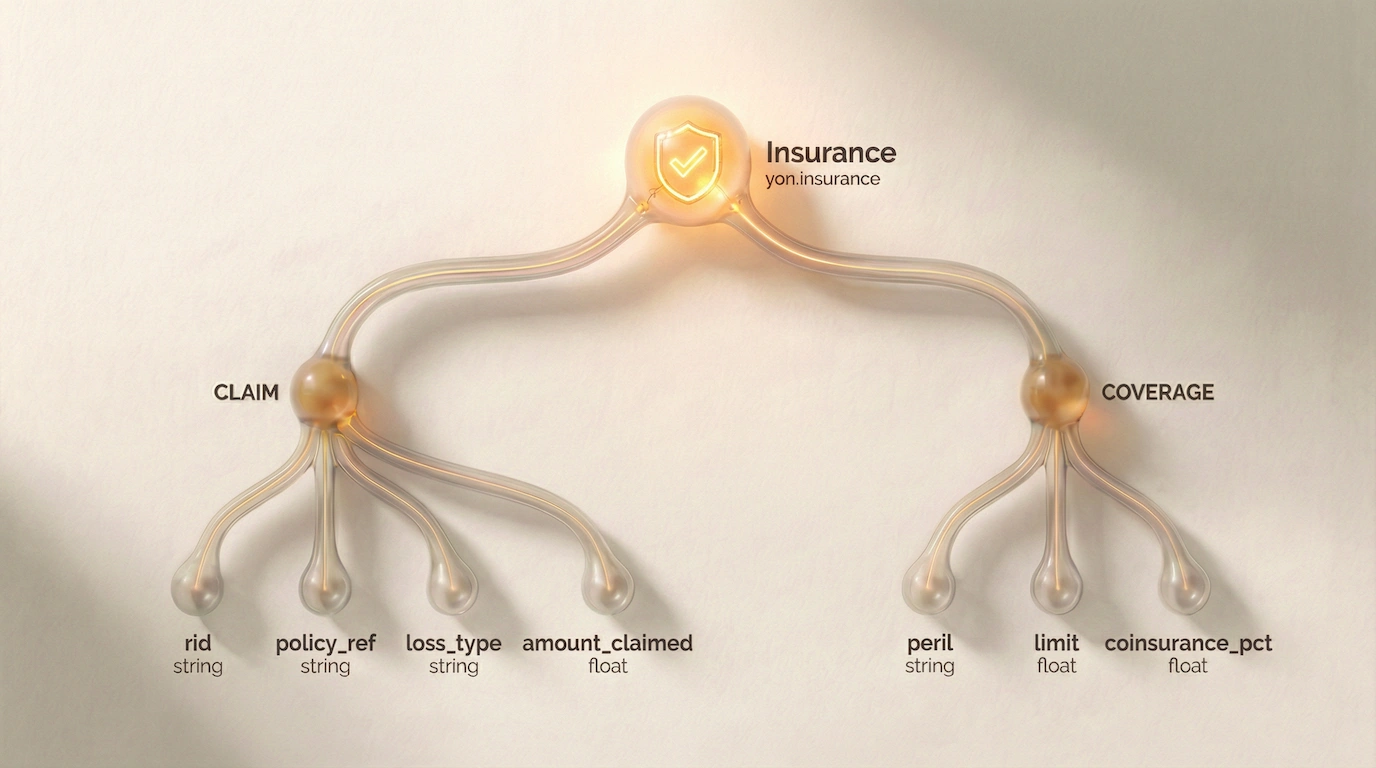
A partial excerpt from yon.insurance — 2 of 6 record types. The insurance agent reads the discharge, resolves CLAIM and COVERAGE from its own schema, and files the claim.
View full schema →YON — YounndAI Object Notation
@DOC ver=2.0 | id=claim-9102 | title="Medical claim" | domain=yon.insurance | profile=audit
@CLAIM rid=cl:9102 | policy_ref=pol:44821 | loss_type=medical | amount_claimed:float=535.00 | status=approved
@COVERAGE rid=cov:1 | policy_ref=pol:44821 | peril=medical | limit:float=100000.00 | coinsurance_pct:float=80
@STAMP ts:ts="2026-02-24T14:31:00Z" | src=agent:insurance-ai | method=generatedyon.fintechDomain Schema (partial)
{
  "tag": "TXN",
  "fields": [
    { "name": "id",       "type": "string", "required": true },
    { "name": "amount",   "type": "float" },
    { "name": "currency", "type": "string",
      "pattern": "^[A-Z]{3}$" },
    { "name": "payment_method", "type": "string",
      "enum": ["credit-transfer","direct-debit",
               "card","wire"] },
    { "name": "debtor",   "type": "string" },
    { "name": "creditor", "type": "string" }
  ]
}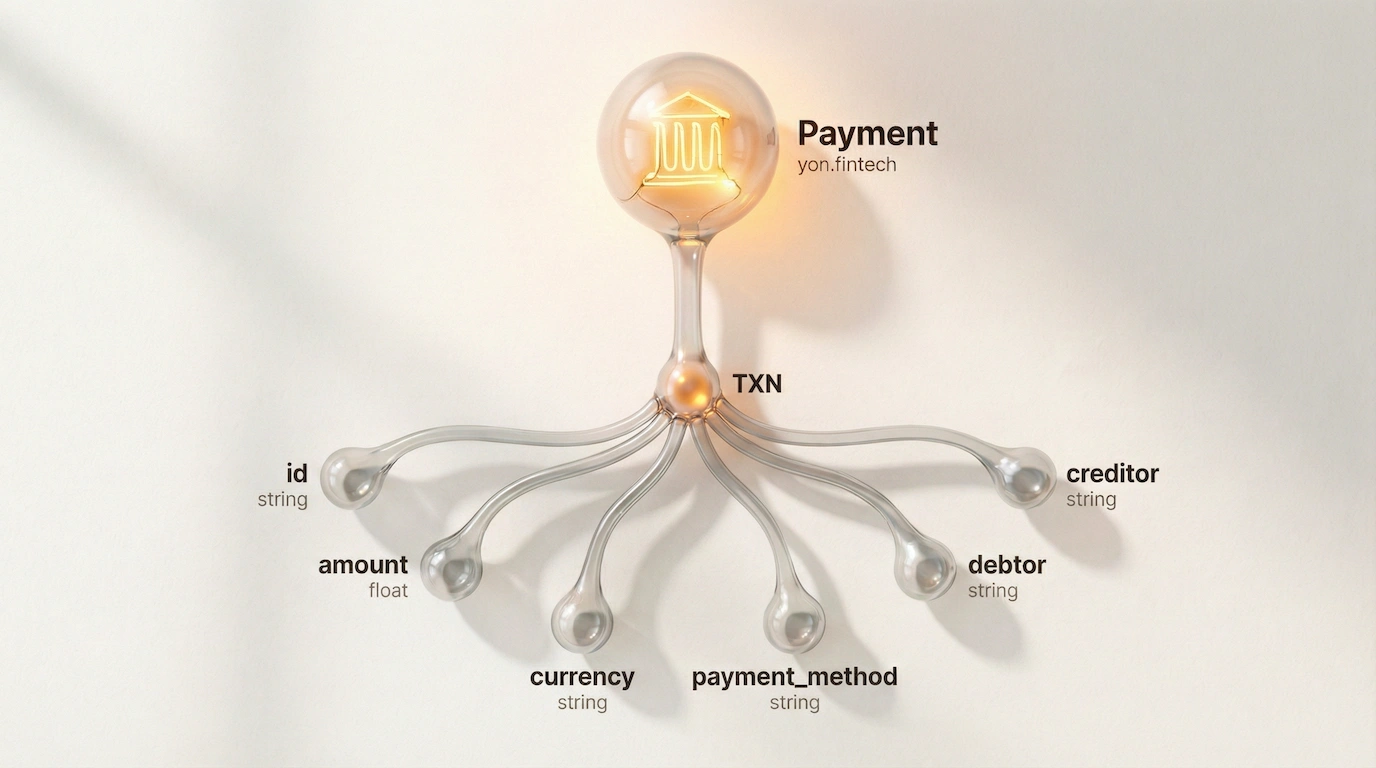
A partial excerpt from yon.fintech — 1 of 12 record types. The payment agent reads the claim, resolves TXN from its own schema, and settles the payment.
View full schema →YON — YounndAI Object Notation
@DOC ver=2.0 | id=settlement-3387 | title="Claim settlement" | domain=yon.fintech | profile=audit
@TXN id=txn-3387 | amount:float=535.00 | currency=USD | payment_method=wire
  | debtor="BlueCross Insurance" | creditor="Memorial Hospital"
  | remittance_info="Claim cl:9102 — patient pt:2847"
@STAMP ts:ts="2026-02-24T14:32:00Z" | src=agent:payment-ai | method=generated
Three agents. Three schemas. Three organizations. Zero integration code. Each agent reads the previous agent's output because the grammar is shared. The vocabulary is looked up.
The Evidence
Measured, not claimed
Cold-Start Generation
3 frontier LLMs. Zero prior training on YON.
Official Domains
Healthcare, finance, logistics, and more.
Converter Roundtrip
6 formats. 13 adversarial strings survived.
Open Standard
Free community tier. No vendor lock-in.